
Why Data Matters in Amazon Selling
Most sellers rely on guesswork when managing Amazon growth. They price randomly, run ads without insight, and ignore customer behavior patterns. That usually leads to weak conversion rates and wasted spend.
When you use data properly, you can see what is working, identify what is not, and make much smarter decisions across the marketplace.
- You understand what is working
- You identify what is not
- You make smarter decisions
Higher sales with better efficiency.
1. Optimize Product Listings Using Data
Your listing is your storefront on Amazon. Data helps you improve the exact elements that influence ranking and clicks.
Use marketplace data to refine keywords, product titles, descriptions, bullet points, images, and A+ content.
- Keywords based on real search terms customers use
- Product titles and descriptions
- Bullet points and feature positioning
- Images and A+ content
- AI suggestions for high-performing keywords
- Competitor listing analysis
- Recommendations for content improvements
Better ranking and a higher click-through rate.
2. Smart Pricing with AI
Pricing can make or break your sales. If your price is too high, conversions fall. If it is too low, you protect revenue but damage margins.
AI-powered pricing systems track competitors, respond dynamically, and help find the price point that balances demand with profitability.
- Tracks competitor prices
- Adjusts pricing dynamically
- Finds optimal price points
Maximum profit and improved conversions.
3. Use AI for Demand Forecasting
Stockouts mean lost sales. Overstock means blocked capital. AI helps sellers forecast demand trends more accurately so inventory decisions are based on expected demand instead of rough estimates.
- Predict demand trends
- Plan inventory better
- Avoid stock issues
Consistent sales without interruptions.
4. Improve Conversion Rate with Data
Traffic is useless without conversions. Strong sellers analyze product page performance, customer reviews, and return reasons to understand what is helping or hurting conversion.
AI can surface what customers like, which images perform best, and what content builds trust on the page.
- Product page performance analysis
- Customer review sentiment tracking
- Return reason analysis
- Best-performing image identification
- Trust-building content recommendations
Higher conversion rates — 30–40% improvement is possible.
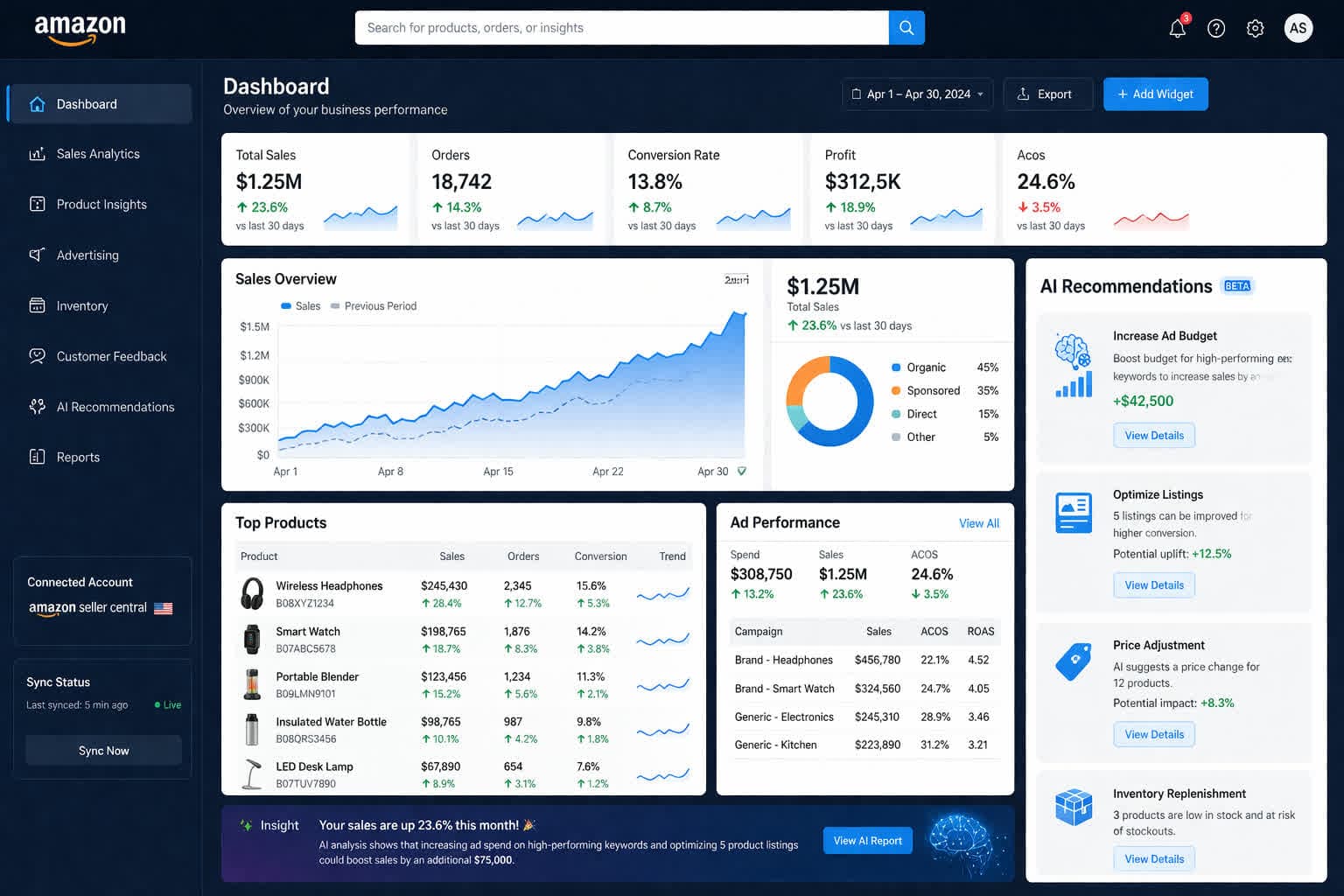
5. Build a Centralized Dashboard
Most sellers struggle because data is scattered across multiple tools. The solution is a centralized dashboard that combines the main business signals in one place.
- Sales data
- Ads performance
- Inventory levels
- Profit margins
- Real-time insights and instant issue detection
Complete control over your business.
6. Optimize Ads with AI
Running ads blindly wastes money. Data helps you identify the keywords and campaigns that actually perform, while AI helps automate and improve execution.
- Identify best-performing keywords
- Stop low-performing campaigns
- Scale profitable ads automatically
- Automate bid adjustments
Higher ROI and lower ad costs.
7. Understand Customer Behavior
Your customers are already giving you valuable information through reviews, questions, and purchase behavior. AI helps turn that raw feedback into something usable.
- Analyze review sentiment at scale
- Track customer questions and patterns
- Identify product improvement areas
- Suggest new product ideas from demand signals
Better products and a stronger brand.
8. Automate Reporting and Decision-Making
Manual reporting wastes time and usually delays action. AI-based automation can generate regular reports, detect performance drops, and recommend what to do next.
- Daily and weekly automated reports
- Alerts for performance drops
- Actionable next-step recommendations
Save 60–70% of reporting time.
Real Business Impact
Brands using data and AI on Amazon typically see stronger performance across revenue, conversions, profitability, and operating speed.
- 2×–3× increase in sales
- 30–40% higher conversion rate
- Better profit margins
- Massive time savings on reporting
Common Mistakes to Avoid
Many sellers invest in tools but still struggle because the execution model is weak. Strategy has to come first.
- Ignoring data entirely
- Making decisions based on assumptions
- Not tracking performance regularly
- Using tools without a clear strategy
Tools do not grow your business. Strategy plus data does.
Final Thoughts
Selling on Amazon is no longer just about listing products. It is about understanding data, using AI for decision-making, and continuously optimizing performance.
Businesses that adopt this approach scale faster and more profitably than those relying on intuition alone.